It's always nice to see someone take such a strong position on something most of us are happy to leave in the grey zone.
Here is a good article about museum displays of human bodies, and an honourable mention for archaeological labs.
Enjoy.
Removing Bodies from Display is Nonsense
Saturday, April 2, 2011

Friday, April 1, 2011
Museum Smell
Awesome. How does a funding review committee keep a straight face...
http://www.guardian.co.uk/culture/2011/mar/27/museums-heritage-smells-university-strathclyde
http://www.guardian.co.uk/culture/2011/mar/27/museums-heritage-smells-university-strathclyde
Northwest Coast
Hey, if you're interested in burial stuff, but getting bored of the aimless ramblings of a student under the gun of an impending deadline, check out my group's website about burials in the Prince Rupert Harbour area. It has a slightly less panicky motif...
Mortuary Archaeology: Prince Rupert Harbour
Thanks!
Mortuary Archaeology: Prince Rupert Harbour
Thanks!
Dog Catacombs
 |
| http://i.livescience.com/images/i/15682/original/ dog-catacomb2.jpg?1301495227 |
Researchers point out that although this superficially looks like a sacrifice, they are calling it a pious dedication linking them to the Gods.
New Sky Burial
Ok, I have no actual pictures, no actual links, no actual evidence... nothing. But, what I have is an idea, and idea which came to light during some group work in class the other day. Here it is...
We have rooftop gardens, why not rooftop cemeteries. Yeah? I knew you'd like it...
We have discussed before about how densely populated areas, and especially those which have been around for centuries - take London for example - are running out of room for their burials. Proper Christian interments are now a few people deep, or even in the ground standing on end. Put six feet of dirt on a relatively flat roof and voila! Space saver!
We have rooftop gardens, why not rooftop cemeteries. Yeah? I knew you'd like it...
We have discussed before about how densely populated areas, and especially those which have been around for centuries - take London for example - are running out of room for their burials. Proper Christian interments are now a few people deep, or even in the ground standing on end. Put six feet of dirt on a relatively flat roof and voila! Space saver!
 |
| http://upload.wikimedia.org/wikipedia/commons/e/e6/ Rockefeller_Center_Rooftop_Gardens_2_by_David_Shankbone.JPG Buried on top of Rockefeller Center? What a legacy. |
 |
| http://www.blog.designsquish.com/images/uploads/green-roof.jpg Yep, looks like a burial to me. |
Blog on a blog
 |
| http://www.favouritegraves.com/ |
I don't want this to come off the wrong way, but beautiful images aside, I would like some information on the shots. Some context... some meat for the bones of their website. Sorry, that was gross and stupid.
I want to include some of their photography below, because it's really interesting looking stuff. Furthermore, they have some great links, so please check it out.
 |
| http://farm3.static.flickr.com/2542/3887705986_0e42b9e3b5_z.jpg |
 |
| http://farm3.static.flickr.com/2583/3887635196_f6194e9406_z.jpg |
 |
| http://farm4.static.flickr.com/3135/3030022251_7ca0a45eb9_b.jpg |
Monday, March 28, 2011
Homelessness and Funeral Rights
Thinking about non-elites and mortuary pattern led me to consider how the unfortunate homeless are treated at death. The information is a little scant, unless discussing US homeless veterans, but here in Canada we'll look at Ontario as an example... because that's what popped up first.
When a homeless person passes away, and there is no family to contact, it is the municipality's responsibility under the Anatomy Act to properly bury the deceased person. The city coroner issues an "Order to Bury" and the city pays the bill for the bare minimum in services. As well, there is cooperation with the free press, who have agreed to print a death notice for one day (cited).
Interestingly, although there seems to be a sense of humanity, there is very much a sense of legality. According to an article by Cory Habermehl on the New Media Journalism website, "unclaimed bodies" receive a funerary service as well, in order to prevent future legal problems.
Apparently, "family or friends who show up after the burial has taken place can claim they were not given the proper chance to say goodbye, and a lawsuit could potentially be filed" writes Habermehl.
Why a family who has no connection to a particular family member, to the point where they were completely unaware of their death, would sue a funeral home for not giving that person a "proper burial" is sort of beyond me. But, I guess that is because of my mainly secular upbringing. Everyone in my family that had passed away during my lifetime has been cremated, and I have only been to one interment of ashes. For me, it is not about all this ritual to make peace, but it is up to an individual to do so for themselves.
When a homeless person passes away, and there is no family to contact, it is the municipality's responsibility under the Anatomy Act to properly bury the deceased person. The city coroner issues an "Order to Bury" and the city pays the bill for the bare minimum in services. As well, there is cooperation with the free press, who have agreed to print a death notice for one day (cited).
Interestingly, although there seems to be a sense of humanity, there is very much a sense of legality. According to an article by Cory Habermehl on the New Media Journalism website, "unclaimed bodies" receive a funerary service as well, in order to prevent future legal problems.
Apparently, "family or friends who show up after the burial has taken place can claim they were not given the proper chance to say goodbye, and a lawsuit could potentially be filed" writes Habermehl.
Why a family who has no connection to a particular family member, to the point where they were completely unaware of their death, would sue a funeral home for not giving that person a "proper burial" is sort of beyond me. But, I guess that is because of my mainly secular upbringing. Everyone in my family that had passed away during my lifetime has been cremated, and I have only been to one interment of ashes. For me, it is not about all this ritual to make peace, but it is up to an individual to do so for themselves.
Sunday, March 27, 2011
Burials.... at Disneyland?!
 |
| http://farm4.static.flickr.com/3360/3337437743_b25c3da566_z.jpg Pet Cemetery at Haunted Mansion |
Now, whether or not these graveyard contain any actual bodies is another story. I guess it is up to an archaeologist to find out.
My wife really wants to take our daughters there, and now I have no excuse. Now we can see princesses and dead bodies... Disneyland is so cool...
 |
| http://3.bp.blogspot.com/_aT16HxfS63I/S7N62NvFdDI/ AAAAAAAABQw/RF__5uNXdRQ/s400/DSC02008.JPG Graveyard on Tom Sawyer's Island |
 | |
|
Sincerely, it is another way to personally memorialize someone. Sure, in this case it also acts as a background for the happiest place on Earth, but as mentioned in some of my other posts, it is about the personal connection to loved ones, as opposed to the show. These people would love knowing they will forever be remembered in this way, at this place. And even though we can take shots at Disney for days on end, this is probably one of the most beautiful aspects of the entire media conglomerate, and we can't shoot them down for that... because they would just erect a snappy tombstone if we did.
 |
| http://www.paulhobson.com/wordpress/wp-content/uploads/2009/11/goodolfred.jpg |
Saturday, March 26, 2011
Status in the Graveyard
A few years ago, my wife and I took a mini-roadtrip through the interior of BC. A friend of our was working at a mine by a town called Likely, and he suggested we go and check out a ghost town called Quesnel Forks. The area was in the midst of a bit of a rebuilding... I suppose in order to entice tourists to travel way the hell out of their way, in the tradition of Barkerville.
There was nothing there, except some run down houses and the old cemetery, perfect for archaeological poking around. The cemetery, for me, was a real eye opener in that one always knows, or assumes, some kind of racist colonialism touched every part of Canada. This town was no exception, as clearly evidenced in the graveyard. Separate areas, with signage, for "whites","Chinese", and "Indians". The status implied here was blatantly obvious...
More to come... It's Earth Hour
...ok, where was I. The status implied was blatantly obvious: the "whites" area had a white picket fence, upkept white crosses (still to this day) and, spatially, was front in center; off to one corner was the "Chinese" area, crosses were there, but not kept; in the opposite corner was the "Indian" area with no upkeep, graves were marked with wooden plaques on the ground, barely visible from where we stood.
Seeing the actual physical separation, even in place where one could carefully assume each deceased was given a "proper Christian burial", was quite interesting. Equally as interesting, is how we can look at this kind of spatial distribution to investigate something as important as colonialism. This cemetery can certainly be used as a metaphor for racist attitudes not only during BC's gold rush, which is when the town was at its most vibrant, but also for attitudes across the country. Unfortunately, I think it would be optimistic at best to think that these attitudes no longer exist. As anthropologists and archaeologist begin to consider and acknowledge the world's colonial past, let us not forget that we, as academics, hover dangerously close to realms of (neo-)colonialism in our work.
(Note: these are not my pictures. Digital cameras were still REALLY expensive when I travelled here. I don't really have time to try and dig up (HA!) my pics and scan them. This person, who took almost 300 pictures, doesn't have a single one showing the "Indian" burial area. Pity.)
 |
| http://inlinethumb54.webshots.com/18613/2856586750033210249S600x600Q85.jpg |
More to come... It's Earth Hour
...ok, where was I. The status implied was blatantly obvious: the "whites" area had a white picket fence, upkept white crosses (still to this day) and, spatially, was front in center; off to one corner was the "Chinese" area, crosses were there, but not kept; in the opposite corner was the "Indian" area with no upkeep, graves were marked with wooden plaques on the ground, barely visible from where we stood.
 |
| http://inlinethumb46.webshots.com/45165/2568692910033210249S600x600Q85.jpg |
 |
| http://inlinethumb63.webshots.com/47358/2605642560033210249S600x600Q85.jpg Ethnicity is still listed on the modern documents out for show. Let's hope it's to keep the original narrative intact. First few lines are pretty telling. |
 |
| http://inlinethumb45.webshots.com/23916/2942404440033210249S600x600Q85.jpg Interesting... the Chinese immigrants were able to maintain some of their tradition. I wonder about the First Nations... |
Sunday, March 13, 2011
China's Wet Mummy
 |
| Chinese Wet Mummy |
What we see here is a burial which got flooded, and as the water became stagnant, the bacteria which would normally break down the body are inhibited. These factors have led to the accidental mummy.
Burial inclusions for the 1.5 meter tall women include a jade ring, silver hairpin, and fully clothed. Archaeologists say that lack of identifying insignia means this woman was not royal, but inclusions suggest she was wealthy.

This is deemed news-worthy as scholars don't recognize the Chinese culture as producing mummies. Therefore, here archaeologists have an opportunity to examine a mummification, and perhaps provide some insight into burial practices from the Ming Dynasty.
Friday, February 11, 2011
Memorials of Victoria's Inner Harbour: A Colonial Present
This post is a class project analyzing the meaning behind the monuments of the dead. Specifically, my group considered the bronze statues located throughout Victoria's Inner Harbour, and I examine the notion that these memorials perpetuate the city's colonial past into the present and future, be it intentional or not.
View Downtown Bronze Memorials (Art) in a larger map
Memorials of Victoria's Inner Harbour: A Colonial Present
View Downtown Bronze Memorials (Art) in a larger map
Memorials of Victoria's Inner Harbour: A Colonial Present
Walking through the main tourist area of Victoria, BC, one is not surprised to find memorial monuments in places of pedestrian thoroughfares. Furthermore, upon consideration of the monuments as a collective unit, one cannot help but notice certain trends emerge, whether intentional or otherwise. Through the examination of our research questions, it is hoped that some inferences become clear, and we will see a trend towards the colonization of the Inner Harbour through monuments as a metaphor for Victoria’s colonial past.
This study will consider all (7) of the anthropomorphic bronze statues memorializing a person or group of people between Johnson Street south to the Legislative Buildings along Wharf Street. This area is constrained by keeping near the water of Victoria’s Inner Harbour, the main tourist area of the city and terminus of many ocean routes. The scope of our data set can be problematized in the very distinct and limited area we chose to survey; additional monuments matching our criteria may be located a short distance away but are left out here. As well, memorial plaques, conveying much of the same information as statues, are bypassed in order to limit the size of the data set and to narrow the focus of research.
Our research questions led to the viewpoint discussed above, but started out much more broad. First, we wanted to see who gets memorialized with a bronze statue. Furthermore, what are the aesthetic qualities of individual statues, and does this lead to any visible collective aesthetic trends? Finally, is the location specific or important to the statues and their interpretation? Through these questions, it will become clear that, as Hay et al (2004:203) clearly state, “monuments and memorials are at once an outcome and a medium of power.”
To begin, who gets memorialized with a statue? Here it is helpful to look at look at the statues in two groups: national heroes and folk heroes. The national heroes stand out in that they can all be linked to war or colonization. For instance, the large memorial dedicated to those who fought and died in WWII, and the statue erected in memory of the Spanish Civil War perhaps glorifying the act of war; or Captain Cook being prominently placed in the center of the harbour walk as one of the founders of the city, and a statue of Queen Victoria gazing out to the harbour both iconic images of the colonization of the area and it’s original habitants. The material culture represented by these statues fits into Shackel’s (2001:657) theory of memory and the exercise of power by excluding an alternative past, reinforcing patriotism, and using nostalgia to legitimize a particular heritage. In other words, the view of the dominant group is being maintained as people pass daily past these bronze images.
The two folk heroes included are Emily Carr, and Michael C. Williams. Emily Carr is certainly recognized on a grand scale, but is known for her painting more than anything. Williams, on the other hand, is probably best known locally, and perhaps this fact lends itself why his memorial is located some distances from the main group. Of note, however, is not who is here but who is missed. With no anthropogenic representation of any indigenous people, it shows how “the construction of a transplanted ‘European’ identity [and] the appropriation of meaning-space by colonists…are being maintained by cultural ascriptions that exclude indigenous people” (Hay et al 2004:213).
Next, to consider the aesthetic quality of the statues is to consider not their condition, but their construction; or more accurately, how they are depicted in posture and what, if any, personal affects are included. The colonial past is exemplified in this: Captain Cook stands tall and regal in full naval attire holding a rolled scroll under his arm – the epitome of the imperial seaman; Queen Victoria is in her full royal regalia: cape, crown and scepter, lording over the harbour on a massive stone pedestal; a WWII and Korean War memorial bronze looms on top of an equally huge stone monument depicting a man in a battle pose with rifle and bayonet. Conversely, a naval monument, instead of presenting the image in a similar fashion, shows a man returning home with a small child and dog running towards him with arm flung wide; heartfelt yes, but nonetheless conveys the sad cyclical nature of work away from home. Each of these examples, although not directly concerned with the colonial past, lends themselves to being interpreted as perpetuating the dominant heritage. Essentially, they “mark out favoured people and histories and ignore others… inculcat[ing] in us views of heritage preferred by dominant groups” (Hay et al 2004:203).
To further consider our folk heroes, we can see Williams holding a glass of wine, and Carr strangely depicted with a small dog at her feet and monkey on her shoulder. People seeing these bronze statues and not knowing of the individuals may construe an entirely unintended meaning. This all of course begs the question: Is this the way they wanted to be remembered? As Schwartz (1991:302) writes, “statues embody memory. They stand for the events and times, the achievements and values, that society chooses to look back on. Focusing thought on one statue after another evokes different categories of remembrance.” These memorials, intended or not, infer more about our society and ideological hegemony then they do about individuals (Hay et al. 2004).
Our final analysis comes in terms of location. All of the memorials in this data set are near the ocean. Some, like Queen Victoria and the WWII monument squarely look out to sea, where as the others do not. A notable example is Captain Cook: he stands very near the water, but faces away. The intent here may be for ease in viewing, or could convey a sense of discovery of a “new land;” a triumph. As Hay (2004:204) states, “The location of a commemorative artefact in the landscape may fortify, dilute or obscure the meanings intended by its producers.” In this case, we have no concept of the producers’ intended meaning, but it is fair to say that as every bronze statue has been erected on land historically and pre-historically utilized by a large indigenous population, the location of the statues certainly fortifies their intended placements. However, as Hay et al. (2004:204) later suggests, “the meanings and interpretations of those commemorative objects and mutable and fluid.” The viewing by the collective of Queen Victoria may no longer be one of prestige but one of contempt; the Navy memorial may fill some with joy, and other’s sadness. It is not just time which changes the reading of the monuments, but each individual’s life history in part dictates how these monuments are seen. The colonial elites can decide where a statue is placed, but they cannot dictate how these places are perceived or understood by the public (Hay et al. 2004:212).
The set of bronze statues welcoming visitors to the city of Victoria are shrouded in imperial history. From locally derived colonial attitudes to overseas national interests, these monuments perpetuate a heritage by which the dominant power maintains a symbolic hold on their people. Who is remembered, how they are presented, and where their statues are erected all help to maintain a collective social memory which chooses to forget.
Work Cited
Hay, Iain, Andrew Hughes, Mark Tutton
2004 Monuments, Memory and Marginalisation in Adelaide's Prince Henry Gardens. Human Geography 86(3):201-216 http://www.jstor.org/stable/3554332
Shackel, Paul A.
2001 Public Memory and the Search for Power in American Historical. American Anthropologist 103:655-670 http://www.jstor.org/stable/683605
Schwartz, Barry
1991 Iconography and Collective Memory: Lincoln's Image in the American Mind. The Sociological Quarterly 32(3):301-319 http://www.jstor.org/stable/4120910
Monday, January 24, 2011
Death as Art
 |
| http://lemonodor.com/archives/000943.html |
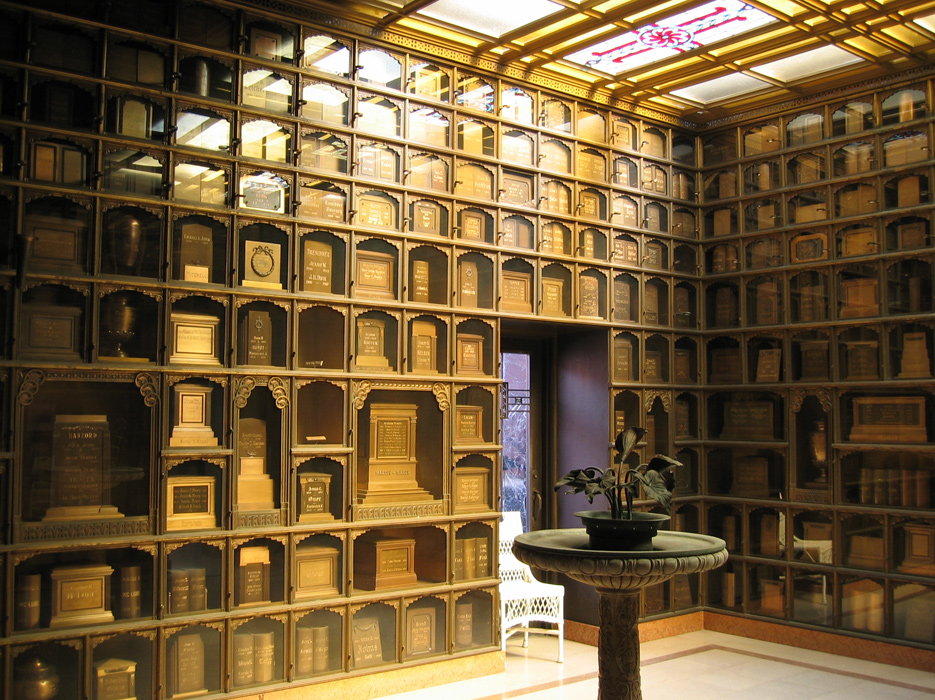
The first is what is called a "columbarium." A columbarium is a room or structure with spaces, or vaults, where cremated remains are stored in urns-I suppose for as long as you want to pay for it, but theoretically forever. I had never heard of these places until this project, but a quick online search reveals they are quite popular. That's why I wanted to include it, plus it is a fabulous picture...
Archaeologiacally speaking, a place like this could resemble the remains of a mausoleum, however actual human remains may not be found as they are by definition cremated. You would also uncover remains of urns provided they are made from a non-organic or non-biodegradable material. These urn would presumably have names and dates which may also alert you to the fact you are digging in a place created for ritual storage of the deceased.
 |
http://designmuseum.org/media/item/61259/58/Carbon-Copy-330.jpg |
The second topic I wanted to share was the work of an artist by the name of Nadine Jarvis (Click here to get a bio). She is challenging post-mortem traditions by creating various object from cremated human remains. Among my favourites are the pencils made with human ash in place of granite, complete with pencil case and sharpener which doubles as an urn. The average human can be made into 240 pencils (dailyundertaker.com).
 |
| http://www.nadinejarvis.com/images/uploads/Bird-feeders_designmart.jpg |
I'm really not sure if either of these treatments would be seen in the archaeological record, at least to the point of discerning any sort of meaning whatsoever. But really, what sort of meanings can archaeologists create out of past funerary rituals? We can make generalizations and educated guesses, but death and the rituals which surround it are so personal, that all we can really do is assume someone was important because of something that was buried beside them. I have relatives who have died and been important to me, but I did not include any personal objects in their internment (or their cremated internment as the case may be), so archaeologically they are just another point a certain distance and direction from the datum.
Friday, January 14, 2011
Grave Bads
Deciding what to include in my grave is difficult, especially since I personally don't plan on being buried. Who am I to take up perfectly good green space with my decaying corpse? In the spirit of the course however, I suppose some contemplation is in order, especially to try and understand how or why certain object appear in graves. But how does a thing represent who a person is? For me, I would want to be remembered for what I had done in my life. And no matter what those things are, everything would go back to my family and what they have achieved in their life. And I am certainly not elite enough to have them buried with me...
Thursday, January 6, 2011
About me
I am an anthropology major focusing on archaeology, which is exactly why I took this course. Unearthing a burial is probably one of the most exciting things for an archaeologist, however I do acknowledge the inherent issues of respect surrounding such excavations.
I am hoping to complete my Masters Degree in Archaeology soon, and would like to work as a contract / professional archaeologist in this geographic area in the future, although you never really know where opportunity can take you. As you can gather from my photo, I am the father of two-and-a-half year old twin daughters, and would like to remain in or close to Victoria for their sake.
I am hoping to complete my Masters Degree in Archaeology soon, and would like to work as a contract / professional archaeologist in this geographic area in the future, although you never really know where opportunity can take you. As you can gather from my photo, I am the father of two-and-a-half year old twin daughters, and would like to remain in or close to Victoria for their sake.
Subscribe to:
Posts (Atom)